.jpg)




It has been quite an adventure for
Commercial Pilot Graduate
Peter Palme since he left the
Lower Mainland in search of
employment up North as a pilot.
Peter hoped to get the edge with
prospective employers and began
applying for work a few weeks
ahead of the projected date he
would qualify as a Commercial
Pilot with a Group 1 (Multi-
engine) Instrument Rating—
sure enough, in April of 2007,
and within day of completing his
qualifying flight test and written
examinations, Peter was on board
a jetliner bound for Yellowknife,
North West Territories.
Peter’s first job in Yellowknife
was not that of a pilot—it was
working on the ramp for Air Tindi.
“Thei dea was that the ramp work
let me get to know the companies
and people up there that hire the pilots,” say Peter. “It seemed like a good idea at the time,” he says, “and sure enough, it paid off.”
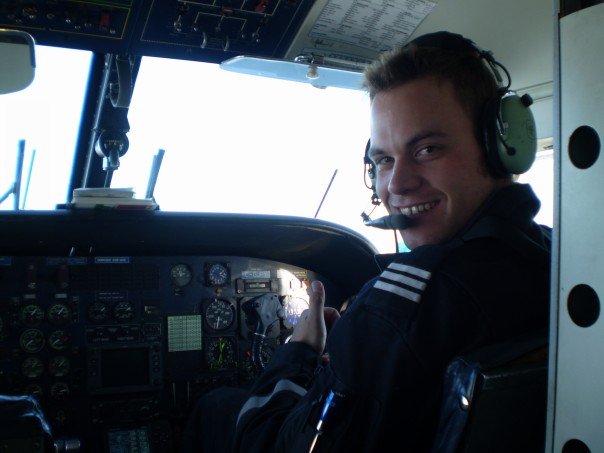
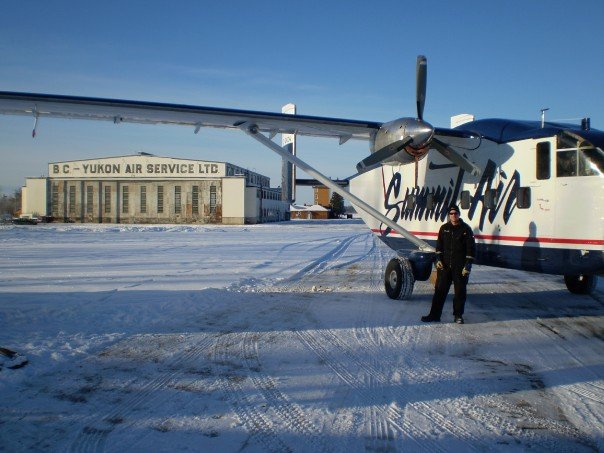
Peter quickly assessed that the hiring prospects at Air Tindi for ramp workers would require about 5 to 7 months service, but that a second company, Summit Air, had a pilot shortage. Peter accepted a job offer to work the ramp for Summit Air, and had been working for only 3 weeks when he got a second offer from the company—the one he had been truly after—a First Officer job on a turboprop aircraft. Within three to four days of the offer and his acceptance, he was the First Officer on the Short SC.7 Skyvan—a 19-seat twin turboprop aircraft manufactured by Short Brothers, which Summit Air uses primarily for VFR cargo haul—and the Dornier Do 228—also a 19-seat turboprop, which Summit Air uses for VFR/IFR passenger services—the 228 has an impressive cruise speed of 230 KTS.
Peter’s routes include frequent flights to Ellesmere Island and Baffin Island and he logs approximately 100 hours per month. Peter is pretty excited about his future prospect with the company. He hopes to make Captain when he has aquired between 1000 and 1400 hours of operational flying, and he thinks he might be able to do this in between a year and a year and a half.
Of all the training Peter received as a student pilot, he feels the Standard Operating Procedures training he received form Captain Gordon Wilson of Safeflight Consulting/Langley Flying School was perhaps the most crucial—“Because of the training I received from Gordon, the basic concepts of two-crew flying was something I was extremely familiar with,” says Peter, “and when it came time to doing my PPC, the crew procedures came easy, and I was able to focus on flying the aircraft and managing its systems.”
Peter began his flight traning in 2001, with his first solo flight completed in August of that year. Peter graduated from Langley Flying School as a Private Pilot in June of 2002, and completed Langley Flying School’s Commercial Pilot, Multi-engine Class Rating, and Instrument Rating Programs in the spring of 2007.
Posted July 16, 2008